
A person changes role. HR updates the record. IT provides the new access. The receiving manager allocates the work.
Yet the person can still change supplier bank details from their previous position. A temporary approval role allows them to approve their own orders. Outstanding matters have a proposed successor, but nobody has confirmed the handover.
Each function has completed part of the transition. The organisation still needs to establish whether the combined result makes sense.
Do responsibility, authority, effective capability and controls remain aligned as a person’s relationship with the organisation changes?
This question connects the six deep dives in our Employee Lifecycle series. It also provides the starting point for the practical model introduced here: eight review questions, an assignment matrix and a shared view of people, roles and systems.
Six perspectives on a changing relationship
The original article introduced the employee lifecycle as a lens for examining fraud risk. The six perspectives remain useful:
| Lifecycle area | Control question | Deep dive |
|---|---|---|
| HIRE | Are identity, status and the basis for organisational trust sufficiently established? | Identity Risk Starts in HR |
| ONBOARD | Which responsibilities and capabilities are being granted, and on whose authority? | Onboarding Turns Identity into Access |
| MOVE | What changes, what must end and what remains justified? | The Fraud Risk of Internal Role Changes |
| REWARD | Which behaviour is rewarded, and how is achievement evidenced? | The Fraud Risk of Incentives and Performance Targets |
| MANAGE | What happens when targets, instructions and control requirements conflict? | The Fraud Risk of Management Pressure and Control Override |
| EXIT | Which capabilities end, and who accepts the responsibilities that continue? | The Fraud Risk of Offboarding and Residual Access |
These areas overlap. Leadership and incentives operate throughout the relationship; internal moves may happen repeatedly. Temporary cover, project assignments and a return as an external adviser can create additional transitions.
The model adds a consistent review structure to this lifecycle perspective. It supports a wider fraud risk assessment by examining how organisational arrangements can create opportunities for abuse, weaken oversight or make events difficult to reconstruct.
What the model connects
Four elements need to be considered separately:
- Responsibility: the work, decisions and control duties someone is expected to fulfil.
- Authority: what that person is authorised to decide, approve or delegate, within defined boundaries.
- Effective capability: what they can actually achieve through their combined access, accounts, delegated powers and practical influence.
- Controls: the arrangements that prevent, detect or challenge inappropriate action, including who performs them and whether they work.
A system may accept an approval that exceeds the person’s business authority. Conversely, a person may be accountable for a task without having the information or access needed to perform it.
The review therefore connects three views: the responsibilities and authority defined for roles; their assignment to particular people; and their implementation in systems and working practices.
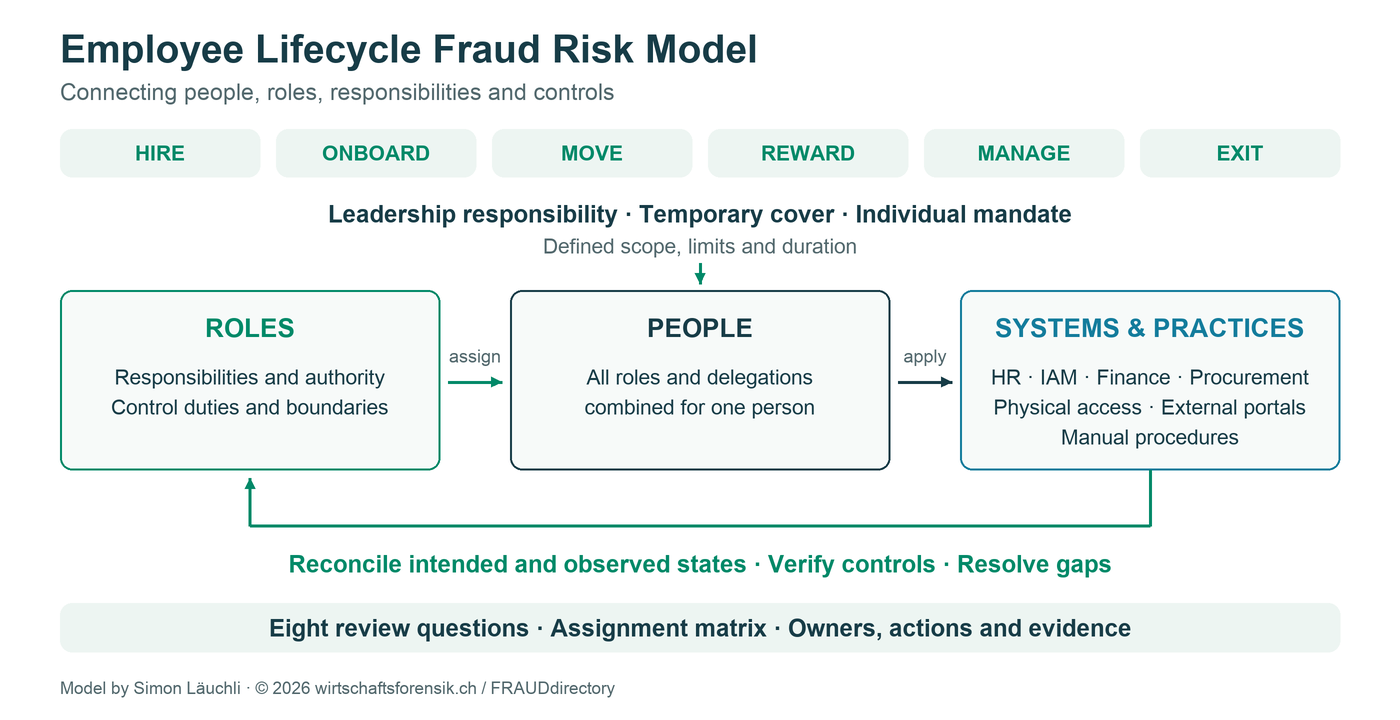
Which arrangements belong to the role, and which to the person?
A job title alone cannot answer this question. A useful review distinguishes three bases for an assignment:
- A business role: for example, preparing purchase orders for an assigned procurement unit.
- An organisational responsibility or leadership role: for example, responsibility for a division, project or defined group of employees.
- An individual delegation or mandate: for example, temporary approval cover or a specific signing authority.
Each needs an identified holder, scope, effective date and appropriate end or review condition. A reporting line can inform an assignment; it does not automatically establish financial authority. An employee, manager or contractor label describes part of the relationship, but does not by itself justify a particular approval right.
Role-based design makes assignments consistent. Person-level review reveals their combined effect. Two separately valid roles can still allow the same individual to perform incompatible steps. The check must follow the person across accounts and systems.
Eight questions for a shared review
| Review area | Question |
|---|---|
| 1. Identity and status | Who is the person, what is their relationship with the organisation, and are the underlying facts reliable? |
| 2. Duties and responsibility | What are they responsible for, and who takes over when they move, are absent or leave? |
| 3. Authority | What may they decide, approve or delegate — within which scope, limits and period? |
| 4. Effective capability | What can they actually achieve across all roles, accounts, systems and delegated powers? |
| 5. Independent control | Which critical combinations exist, and who checks the actual transaction effectively and independently? |
| 6. Incentives and leadership | Which expectations may encourage manipulation, and can someone challenge an inappropriate instruction? |
| 7. Transitions and exceptions | What is granted, ended, time-limited or transferred, and who explicitly accepts the open work? |
| 8. Traceability | Can we establish who was responsible and authorised at the relevant time, what happened and which control operated? |
The answer to each question should identify its evidence and any unresolved work. “Unknown” is a useful finding: it makes an assumption visible and gives someone a specific point to clarify.
The questions also connect behavioural and technical conditions. A well-configured approval process can be weakened by pressure to bypass it; a conscientious employee may inherit capabilities that nobody has reviewed.
A worked example: Lea moves into procurement
In this fictional case, Lea moves from supplier master-data maintenance into operational procurement on 1 December. Her new role includes preparing purchase orders. Separately authorised temporary cover allows her to approve orders raised by others, within defined limits, until 14 December.
A review on 3 December finds that her former master-data access remains active. Her additional approval role permits self-approval and has no technical expiry date. Twelve open master-data matters are intended for Amir, but his capacity, access and acceptance of the handover have not been confirmed.
The assignment matrix records the intended arrangement separately from the observed position:
| Responsibility, authority or control | Intended assignment | Observed position and required follow-up |
|---|---|---|
| Prepare purchase orders | Lea’s procurement role, from 1 December. | New functions exist; confirm their effective scope against the approved role. |
| Approve other people’s orders | Lea’s individual cover arrangement, ending 14 December. | Self-approval is possible and technical expiry is missing. Correct both and test the result. |
| Enter supplier bank-detail changes | Amir’s master-data role; independent verification remains necessary. | Lea retains access; Amir’s required access is unconfirmed. Reconcile the transition and any justified temporary exception. |
| Follow up twelve open matters | Amir, with the information, authority and capacity to act. | Handover is unconfirmed. Obtain acceptance and appoint an interim owner until the gap is resolved. |
| Independently verify bank-detail changes | Nora’s control role, excluding her own entries. | The control is specified. Establish its authority and verify its operation in the actual workflow. |
The full working record adds the scope, validity, authorisation, evidence, responsible person for clarification and target date for each assignment.
No misuse has been established. Retained master-data access and order approval do not demonstrate an ability to release payments. Downstream verification and payment controls require separate examination.
The findings are nevertheless actionable. The business owner defines the permitted approval scope; the responsible technical owner implements it; an appropriate reviewer confirms that Lea can approve eligible orders but cannot approve her own. The cover arrangement must also expire as intended.
For the open matters, naming Amir is only the beginning. Someone must establish what he receives, when he becomes responsible, whether he can act and whether he accepts the handover. Where this remains unresolved, an interim owner keeps the work visible.
Responsibility transfer is a control activity in its own right. Removing the former holder’s access does not establish that someone else can perform the work.
The incentive question also matters: if completion is judged only by how quickly the transfer ticket closes, unresolved approvals and handovers may disappear behind a completed status. The review should make those outstanding conditions visible.
Across systems, with clear ownership
HR, identity and access management, Finance, procurement, physical access and external portals hold different parts of the picture. Manual procedures and informal working arrangements can add capabilities that no access list fully describes.
The model’s architectural implication is to define an authoritative owner for each relevant fact. HR may own employment status and the effective date of a move. A business owner authorises purchasing authority. A system owner implements the corresponding permissions. Evidence then establishes whether the intended restriction actually operates.
For system providers and integration teams, this suggests a useful design requirement: preserve the connection between the person, the business role, the assignment basis, scope, duration, approval and implemented capability. Keep the intended state distinguishable from the observed state, and retain the history needed to explain changes.
A department, grade or manager field should drive financial permissions only where an explicit, approved business rule establishes that relationship. Otherwise, integration can reproduce an assumption across several systems without resolving whether it is valid.
A shared review needs a coordinating owner and named owners for the required actions. Leadership and process owners define and accept responsibilities; HR establishes the personnel change; Finance and procurement examine business authority and segregation of duties; IT establishes effective access. Compliance and risk specialists can challenge the arrangements. Internal audit can independently assess their design and operation without taking over management’s decisions.
The resulting audit trail should distinguish the approval date, business effective date, technical implementation and verification. These moments may differ. Recording them helps explain an exposure window without assuming that an active account proves who acted.
Reference foundations and limits
The model was developed by Simon Läuchli, drawing on published control principles and his professional experience at the intersection of HR, technology and governance. Its eight questions, assignment matrix and lifecycle connection form his editorial synthesis, published through wirtschaftsforensik.ch / FRAUDdirectory.
- U.S. Government Accountability Office (GAO, USA), Green Book 2025: responsibilities and authority, response to organisational change, and monitoring provide reference points for the review structure. See Principles 3, 9 and 16.
- National Institute of Standards and Technology (NIST, USA), SP 800-53 Rev. 5: AC-5 addresses separation of duties across systems; AC-6 addresses least privilege; PS-5 addresses access changes on transfer; PS-4 addresses termination. These support the capability and transition questions. See the NIST source record.
- United States Department of Justice (DOJ, USA), Evaluation of Corporate Compliance Programs, September 2024: management conduct and compensation practices provide reference points for examining incentives and the practical operation of controls. See sections II.A and II.C.
These publications originate in the United States and have different purposes. They are used here as control-design references; their legal applicability depends on context. They support individual elements and do not validate or endorse this model as a whole.
The model is a practical review framework, not a predictor of individual misconduct or a complete fraud taxonomy. It has not been empirically validated. Its usefulness should be tested through documented applications and refined in response to findings. Collusion, management override and incomplete evidence remain relevant even where responsibilities appear clearly allocated.
Try the first practical application
The free Role Change Risk Check applies the model to internal moves. It offers the fictional procurement example and a workspace for reviewing a role change in your own organisation.
You can record assignments, work through the eight questions and produce an action record. The tool supports English and German, local saving and loading of a case file, and a printable PDF. Case entries remain in the browser window and are not uploaded to the website; saving a case file is necessary to resume later.
The results reflect your entries. They make unresolved work visible and support a shared review; they do not provide a fraud score or an independent audit opinion.
Start with one transition. Bring together the people who understand its business purpose, personnel arrangements and technical implementation. Then establish what changes, who accepts the continuing responsibilities and what evidence will demonstrate completion.
A transition is complete when the intended responsibilities, authority and controls have been reconciled with what people can actually do.